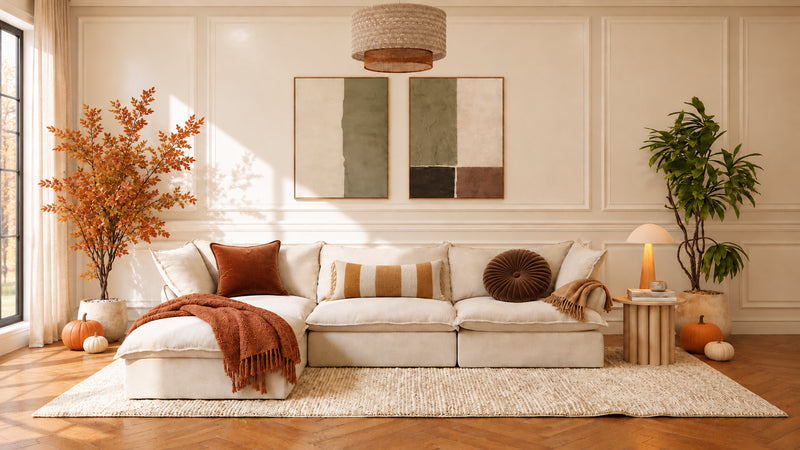
How to Separate a Sectional Sofa and Make It Look Good

To separate a sectional sofa, remove the loose cushions, find the connectors where the seat bases meet, and release each joint according to your model’s assembly guide. With a second person, move the pieces one at a time, holding them by the base. To make the new layout look intentional, arrange the seating around a shared rug or focal point and keep a clear route through the room.
A chaise that blocks the route from the entryway to the kitchen may only need a small change. A U-shaped sectional with two removable ottomans can feel quite different when the ottomans move out of the ends. Start by deciding which part of the layout you want to change, then see which pieces your sofa lets you move.
Can your sectional be separated?
Check whether the seat bases are designed to come apart and whether the pieces you plan to move can be used on their own. A sectional can come apart for delivery while still relying on adjoining pieces to form the intended seating arrangement. Look at the assembly guide and check the exposed side of each piece for unfinished upholstery, hardware, or a missing arm. A corner or armless module may work best as part of a smaller connected group.
| What you have | What you can change |
|---|---|
| A modular sectional with separate seat bases | Move individual modules that are designed for independent use, or reconnect compatible modules in a smaller layout. |
| A sectional with a freestanding ottoman | Move the ottoman to create an open end or use it in the middle of the seating area. The seat modules can stay together. |
| A sectional with a detachable chaise section | Check whether the chaise can stand on its own and whether the remaining seats have a finished end. |
| A sofa with one continuous frame or an integrated chaise | Rearrange the sofa as a whole or adjust the furniture around it. Follow the manufacturer’s guide for any detachable parts. |
If you’re still deciding which type of sofa fits your room, see our guide to modular sofas versus sectionals.
How to disconnect sectional sofa pieces
- Take a photo before you begin. A wide shot records the layout, and a close-up of each joint gives you a reference when you reconnect the pieces. If several modules look alike, label them by their original position.
- Clear the area and remove loose cushions. Move the coffee table and anything you might trip over. Set the loose seat and back cushions aside so you can see the seams between sections.
- Find the connectors between the seat bases. Look where the upholstered bases meet and check the underside near that seam if your manual shows hardware there. Use a flashlight and ask someone to steady the module if you need to reposition it to see the joint. Check whether there’s more than one connector along the seam.
- Release the joint in the direction shown for your model. Some connectors release when you lift the designated section. Others use a latch and a sliding motion. Follow the assembly diagram for your sofa. If a section resists, set it back down and check for another connector or an alignment issue before trying again. Avoid prying against the upholstery.
- Move one module at a time. Once the joint is free, have one person on each side of the module. Grip the base and lift it clear of the floor. Avoid carrying it by an arm, backrest, or connector. Set each piece on a level surface and store any loose hardware with its module.
- Check the pieces before using the new layout. Confirm the legs are secure and the bases sit flat. Reconnect modules that are meant to form a single seating unit. If a piece wobbles or has exposed hardware where someone could brush against it, check the manufacturer’s instructions before using it in that position.
What if the sectional pieces won’t come apart?
Look for a second fastener along the joint, then check whether the guide shows a particular side releasing first. A sectional that has shifted slightly can also put pressure on a connector. Set both pieces level before checking the joint again. If the hardware appears bent, hidden behind a fixed panel, or different from the diagram, take a photo and ask the manufacturer to identify it.
How to separate Sofie Home CloudComfort™ modules
Start with the instructions for your exact CloudComfort™ configuration. The Luxe guide shows how the metal fittings on the armrests and backrests slide into brackets on the seat base. Those fittings attach parts to an individual seat. To rearrange the sectional, look for the connection between neighboring seat bases.
- CloudComfort™ Luxe. If your layout uses a freestanding ottoman, move it first. For a seat-to-seat joint, use the connection instructions supplied with your configuration. The Luxe assembly guide shows the parts of each module.
- CloudComfort™ Classic. Open the Assembly Guide section on the product page for your configuration and compare its diagrams with the hardware on your sofa. For reference, here’s the Classic assembly PDF linked from the Classic 2-Seater product page.
If the diagram leaves the seat-to-seat release unclear, send Sofie Home support your order number, configuration name, and a photo of the joint. Include the side of the sofa where the pieces meet so the team can identify the connection.
Three before-and-after layouts for a separated sectional
Choose a layout based on the route people take through the room and where they spend the most time. The examples below work with pieces designed for the positions shown.
| Before | After | Best when |
|---|---|---|
| L-shaped sectional with a freestanding ottoman creating the chaise | Straight sofa with the ottoman on the open side of the rug | The chaise projects into a doorway or a route through the room. |
| Modular sectional with a branch extending into the room | Compact connected sofa with a standalone armchair angled toward it | You want a place to talk or read while keeping the center of the room open. |
| U-shaped sectional with two freestanding ottomans | Straight seating row with one ottoman in the center and the other beside a wall | You want to open both ends of the seating area and keep a footrest within reach. |
1. Turn a chaise layout into a straight sofa and floating ottoman
If a freestanding ottoman completes your chaise, move it away from the traffic side of the sofa. Place it in front of a seat on the quieter side so someone can still put their feet up. Leave the end nearest the doorway open and walk through the route to see whether you can pass comfortably.
Keep the ottoman partly on the same rug as the sofa so the two pieces still read as a group. If your chaise is an integrated seat, check whether the manufacturer offers a shorter configuration that uses the pieces you already own.
2. Create a compact sofa and a separate conversation seat
Reconnect the compatible seats as a shorter sofa, then angle a module designed as a standalone chair toward the sofa. In a long or narrow room, try positioning the chair diagonally at one end of the rug. This gives the two seats a shared focal point without creating a solid wall of furniture across the room.
Use a side table or floor lamp to give the chair a purpose. If the piece you separated has a single arm or an unfinished side, keep it in the connected layout and use a standalone armchair for the second seat.
3. Open up a U-shaped sectional with separate ottomans
If your U shape comes from two freestanding ottomans, leave the main row of seats connected and pull both ottomans away from the ends. Center one in front of the sofa as a footrest. Set the other beside a wall or window, where it can serve as a second footrest when you need it.
Before settling on the arrangement, open nearby doors and drawers and walk through both ends of the seating area. If the center ottoman takes up too much space, move it alongside the quieter end of the sofa.
How to make separated sectional pieces look cohesive
Start with the room’s focal point. It might be the TV, a fireplace, or the coffee table where people gather. Place the largest piece first and position the remaining seats so they look and feel connected to that spot.
- Use one rug to define the seating area. Where space allows, put the front legs of the sofa and chair on the same rug. If a rug is too small to reach both, center it on the coffee table and bring the seating in around it.
- Repeat one color or texture. If a detached seat feels visually disconnected, echo a pillow color, a throw, or a wood finish from across the room.
- Measure the whole footprint. Account for the full width and depth of the bases, especially near a doorway or corner. Our apartment sofa size guide shows how to check furniture dimensions and entry clearances.
- Test the layout in daily use. Sit in each seat, reach for the table, and walk the busiest route. A good floor plan makes those small movements easy.
Frequently asked questions
Can I separate a sectional without flipping it over?
Yes, if the connectors are reachable and designed to release while the sofa is upright. Some models require access from underneath. Use the manual to identify the connection and get help if the module needs to be repositioned.
Can I use an armless sectional piece as a chair?
Use an armless piece on its own only if the manufacturer supports that setup. Check that it has a complete base, a secured backrest, finished exposed sides, and no protruding hardware. A purpose-built standalone module is another option if you want a separate chair.
Can I switch a sectional chaise to the other side?
You can switch sides if the manufacturer lists the chaise as reversible or the layout uses a freestanding ottoman. With a fixed left- or right-facing chaise, check the assembly diagram and the available configurations before moving it.
How do I keep separate sectional pieces from sliding?
Reconnect modules designed to stay together using the original hardware. For pieces designed to be freestanding, such as an ottoman, use floor-safe nonslip pads if the manufacturer permits them. Choose pads suitable for your flooring.